


HOW GARMENT CONVEYORS WORK
Automated Garment Conveyor Workflow should be planned around the real workflow. An automated garment conveyor moves hanging storage positions along a powered track so staff can bring a selected section to the loading or retrieval point. The technology is simple; the value comes from fitting the path and identification method to the real storage job. A practical automated garment conveyor workflow project starts with room dimensions, garment size and peak retrieval flow.
Automated Garment Conveyor Workflow: Understand the mechanical workflow
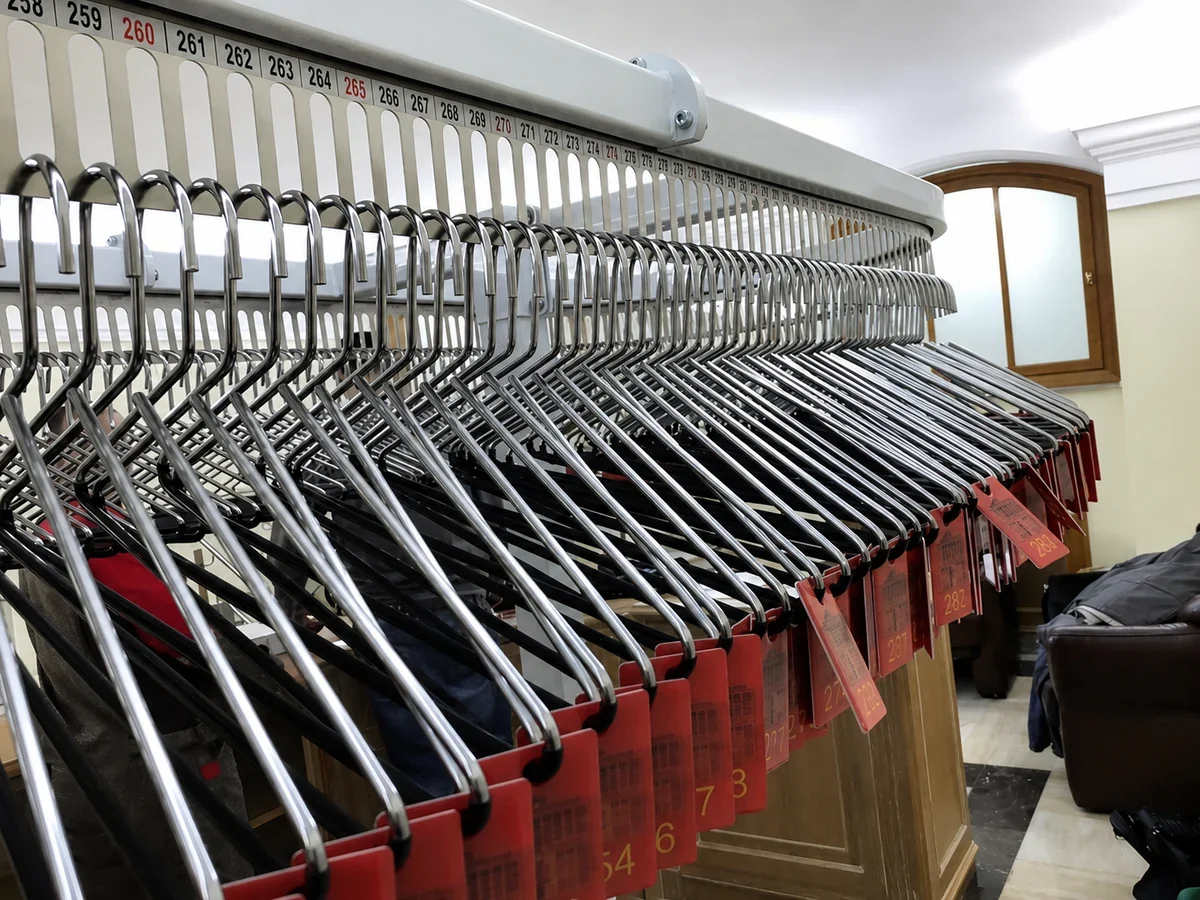
Garments are placed on numbered positions or hangers. The conveyor moves the storage path until the desired position reaches the operator. In a basic system, the operator can move the conveyor manually with controls. In a search-enabled system, a position number can be entered so the conveyor moves toward that location automatically.
Measure the operating envelope, not only the room
Record usable length, width and height, but also doors, columns, sprinklers, electrical panels, worktables and required service access. Hanging garments swing beyond the metal track, so clearance around the conveyor matters. Long coats, gowns and garment bags need more vertical and side clearance than shirts or short jackets.
Capacity depends on garment mix
Theoretical hanger positions do not equal comfortable operating capacity. Thick winter coats need more spacing than shirts; long gowns may prevent a lower tier from being used. Plan from the real garment mix and peak inventory, then keep some spare capacity so staff are not forced to pack every position tightly.
- Typical garment length and thickness.
- Peak number of stored items, not only daily average.
- Single-tier or multi-tier possibilities.
- Clearances for garment swing and operator access.
- Future growth allowance.
Choose the conveyor path around the room
Track shape should use the room efficiently while keeping the operator station convenient. The conveyor is not a fixed straight rack; its path can be selected around the available footprint, but every turn and tier still needs garment clearance. The automated garment conveyor workflow layout should leave enough working clearance for garments, staff and service access.
Retrieval speed is a workflow question
Search works best when the business already has a reliable number tied to the garment, order or customer. If staff cannot consistently assign the number, faster motorized movement will not solve retrieval mistakes.
Design for peak periods
Track average search time, misfiled garments and capacity utilization. If retrieval remains slow even when the conveyor moves quickly, the identification workflow is the likely bottleneck.
Common conveyor planning mistakes
- Using wall-to-wall dimensions without garment clearance.
- Quoting capacity from empty hanger positions instead of real garments.
- Ignoring the busiest arrival or pickup period.
- Placing the operator where customers block the retrieval path.
- Choosing multi-tier storage when garment length makes the lower tier impractical.
- Forgetting service access, power and a way to identify positions.
What to send before requesting a layout
Provide a room sketch with dimensions, ceiling height, doors and obstacles; garment type and maximum length; peak quantity; desired operator position; and whether number search or another retrieval method is required. Photos of the room help confirm practical clearances before a final layout is selected.
Related planning guides
A practical commissioning example
Automation adds the most value when staff repeatedly need to find specific garments among many positions. A conveyor can bring a numbered position to the loading point, but the business still needs a dependable rule linking the garment to that position. That link may be a ticket, order number, employee ID or software record. Designing this identification rule at the same time as the mechanical layout prevents the conveyor from becoming fast storage with a slow manual search process.
How to validate the workflow before full rollout
Load a representative sample, assign each item to a position using the intended workflow and ask an employee who did not create the records to retrieve random items. Include a moved item, an empty position and a new item added during the test. This checks whether the operating method remains understandable when the original installer or manager is not standing beside the system.
Decisions to make before ordering
- What identifier will staff use to search for a garment?
- Who assigns and changes conveyor positions?
- Is the storage sequence fixed or dynamic?
- How often are garments added and removed during the day?
- What manual fallback is used if position data is temporarily unavailable?
Write these answers into the project scope before comparing equipment. They create an acceptance target for the installer and a training reference for the employees who will use the system later. If one of the answers changes, update the scope before adding hardware so the installation continues to solve the operating problem described on this page.
Project handover and future expansion
For automated garment conveyor: how storage and search work, keep a short handover record with the final layout, equipment locations, naming convention, normal operating steps and the person responsible for routine changes. Record the settings that were proven during acceptance instead of relying on memory. This makes later service, staff training and expansion much easier.
Expansion should follow a new operational requirement: another entrance, a larger inventory, additional reports, a new department or a need for remote visibility. Add the smallest component that solves that new requirement while preserving the working first phase. A modular project is valuable because the original installation remains useful rather than becoming a disposable pilot.
Recommended implementation sequence
Freeze the layout only after a room-fit review with real garment dimensions. Mark the conveyor footprint, operator position, loading point and service clearances. Then verify capacity using the expected hanger spacing rather than a theoretical maximum. Search or position-control functions should be tested with randomly selected locations so the operator workflow is proven as well as the mechanical movement.
For handover, record the position-numbering method, safe loading rules and basic recovery steps. When capacity grows, use the same planning logic for an added tier, another conveyor or a changed layout; do not assume that increasing the number of positions automatically preserves garment clearance or retrieval speed.
Frequently asked questions
How much extra space should be allowed around a garment conveyor?
Allow practical garment swing and service clearance beyond the track itself; the exact allowance depends on garment size and layout.
Is the highest hanger count always the best design?
No. Usable capacity and retrieval flow are more important than theoretical maximum positions.
Can garment conveyors use number search?
Search/control options can be added when faster retrieval is useful for the application.
Can an automated conveyor be used without software?
Yes. Motorized rotation and simple controls can be useful without a database; digital search can be added when required.