


GYM TOWEL LOSS GUIDE
Gym Towel Loss Prevention should be planned around the real workflow. Gym towel loss is usually a workflow problem before it becomes a technology problem. Towels can leave with members, remain in lockers, move into the wrong laundry stream, sit uncounted in return carts or disappear because the facility never established a reliable inventory baseline. This guide explains how to find the real loss point and then choose the simplest control that addresses it. A practical gym towel loss prevention workflow begins by mapping issue, use, return, storage and the point where exceptions occur.
Gym Towel Loss Prevention: Why gym towels disappear
When a fitness club sees its towel purchases increasing, the natural explanation is theft. Unauthorized carry-out can certainly be part of the problem, but it is not the only cause. A towel may remain in a locker overnight, be thrown into the wrong cart, move to a spa or pool area, be mixed with another property’s linen at an outside laundry, be damaged and discarded without a record, or simply never be counted correctly after delivery.
Those causes require different responses. An exit alarm cannot fix a laundry-counting problem, and a smart cabinet cannot tell management whether a return cart was emptied into the wrong processing stream. The first useful step is therefore to map the complete towel cycle and identify where the numbers stop matching.
Map the towel lifecycle from clean stock to return
- Receiving. How many clean towels arrive from the laundry or internal processing area?
- Clean storage. Where are towels held before they are made available to members?
- Issue or pickup. Are towels freely available, handed out by staff or dispensed from controlled storage?
- Use. Can towels move between fitness, pool, spa, locker and treatment areas?
- Return. Where are members expected to leave used towels?
- Collection. Who empties return bins or carts, and how are those quantities handled?
- Laundry. Are towels processed on site or transferred to an outside laundry?
- Restocking. Is clean stock counted when it returns to service?
A simple written map often reveals weak points immediately. If staff cannot describe the return process consistently, the business may have an operational loss before any towel reaches an exit.
Establish a baseline before installing loss-prevention equipment
For a defined period, record clean stock, issued or available quantities, returned quantities, laundry transfers and new towel purchases. The purpose is not perfect accounting; it is to learn where inventory differences appear. If the facility cannot establish a rough baseline, it will also be difficult to prove whether a new anti-theft or towel-management system improved the result.
Physical inventory can be performed by count, by weight in some operations, or with tagged items and a handheld reader when individual identification is part of the workflow. The right method depends on the level of control the business wants. The gym towel loss prevention process should be easy for staff and users to follow during normal daily operation.
Make towel return easier than towel carry-out
Behavior changes when the correct action is obvious and convenient. Return bins should be easy to see from locker rooms, pool exits and changing areas. Signs should use simple language. Staff should not place return carts in locations that require a member to walk toward the building exit before seeing where a towel belongs.
These changes sound basic, but they matter because technology should reinforce a good process rather than compensate for a confusing one. A facility can reduce accidental losses with layout and signage before adding any monitoring equipment.
Three practical levels of towel-loss control
Inventory and reconciliation
Regular counts establish whether losses are stable, improving or becoming concentrated at a specific location.
Exit monitoring
A monitored doorway can create a local alarm or software event when a registered towel passes through the controlled exit.
Controlled issue and return
A smart cabinet or controlled dispensing point can add member accountability and create a defined clean-towel workflow.
These levels are not mutually exclusive. A gym can begin with inventory and exit monitoring, then add a controlled cabinet later if it needs to know which member received specific items or how many towels remain outstanding.
When exit monitoring is the right tool
Exit monitoring is useful when the business has evidence that towels are leaving through one or more predictable doors. The monitored zone should be physically defined so the system does not create unnecessary alerts from towels moving inside the club. Staff also need a policy for what happens after an alert. Technology can indicate that a registered item is crossing the exit zone, but the business must decide how employees respond.
For simple loss prevention, the goal may be only a local light or sound alert. A larger facility may want software events, several monitored exits or notifications. The system can be scaled to the operating requirement.
When controlled towel dispensing is more useful
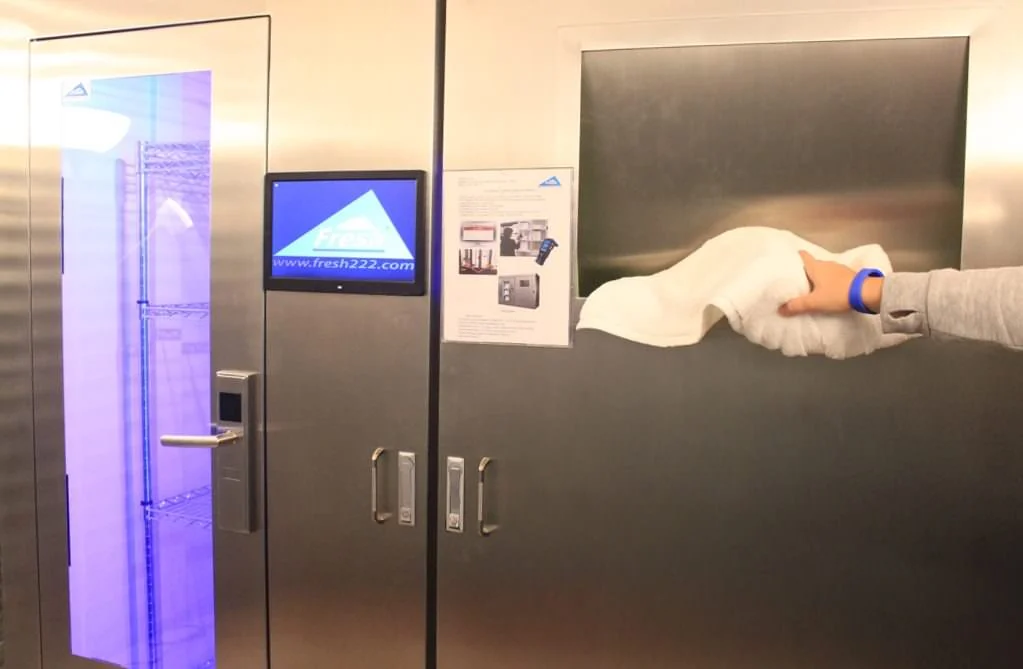
A smart towel cabinet changes the process earlier. Instead of waiting until a towel reaches an exit, the business controls access to clean inventory. Depending on the integration and policy, a member credential can be used to authorize access and the cabinet can record issue activity. A return bin or other return process then closes the loop.
This approach is useful when the club wants accountability, limits, automated availability or a cleaner self-service process. It is more involved than simple exit monitoring, so it should be selected because the operation needs those functions, not because it is the most advanced option.
Do not forget the laundry process
Washable tags, when used, must survive the real commercial laundry process. Temperature, extraction pressure, drying and finishing conditions should be considered. The business should also decide whether it needs to track individual towels through laundry or only verify stock at receiving and return points.
Outside laundry service creates another handoff. Quantities sent and received should be reconciled so the gym does not misclassify laundry differences as member theft.
Common mistakes in gym towel-loss projects
Assuming every missing towel was stolen
Loss can occur in lockers, carts, laundry processing and internal transfers.
No baseline
Without a before-and-after count, management cannot measure whether the new process helped.
Poor return-bin placement
A member should see the normal return point before approaching an exit.
Monitoring the wrong doorway
The read zone should correspond to the real exit path, not just the easiest mounting location.
No staff response policy
An alarm is only useful when employees know what action is appropriate.
Overcomplicating the first stage
Start with the smallest system that solves the confirmed loss mechanism and expand later.
What information helps design a gym towel-loss system?
Provide the number and width of exits, daily towel circulation, whether towels are free or assigned to members, current return-bin locations, laundry method, approximate towel inventory and any evidence about where losses occur. Photos of the exit and locker-room flow are useful. If member-card integration is being considered, include the credential type and how the membership database can provide active IDs.
This page is an informational guide about reducing towel loss. Current Fresh USA equipment, smart cabinets, readers, tags and system configuration are kept on the main commercial site to avoid mixing the informational intent with product-shopping intent.
Gym towel loss FAQ
Do we need a smart cabinet to reduce towel loss?
No. A facility can begin with better inventory, return workflow or exit monitoring and add controlled dispensing only if member accountability is needed.
Can a monitored exit tell staff which member has a towel?
Not necessarily. Basic loss-prevention monitoring can simply detect a registered towel at an exit. User assignment is a separate workflow.
Can towel tags survive commercial washing?
Purpose-built textile tags are designed for repeated laundry use, but the tag must match the real washing, drying and finishing conditions.
Should every exit be monitored?
Only exits that represent a meaningful loss path need monitoring. The design should follow the actual member flow.
How do we know whether the project is working?
Compare towel purchases, periodic inventory and return or laundry reconciliation before and after the new process is introduced.
Related planning guides
For the next planning step, see towel issue and return workflow and anti-theft towel exit monitoring.